TASIKMALAYA, Thecuy.com – The school revitalization program is not merely about how many buildings are repaired or how much funding is allocated.
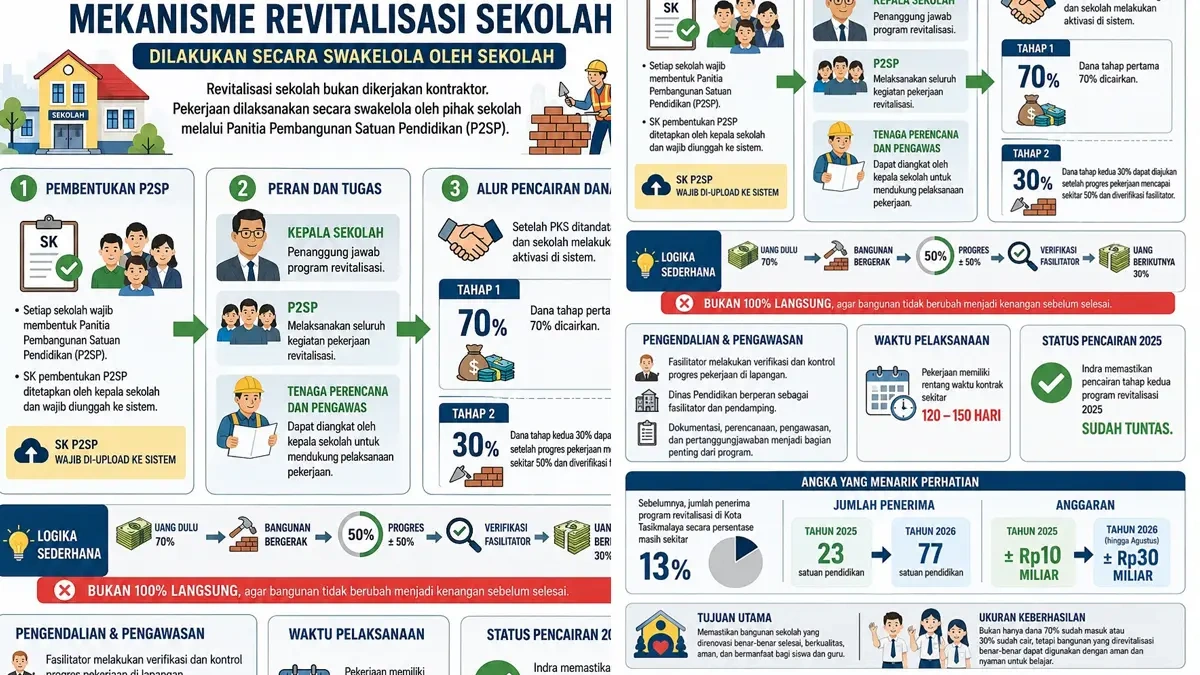
There is a process that must be followed. And there is one crucial point to underline: the revitalization work is carried out in a self-managed manner by the school through the Education Unit Development Committee (P2SP).
This means that schools are not just beneficiaries. Schools also play an important role in the implementation of the work.
RAJA PLT: Satu Hanafi, Banyak Kursi! Enjang Why Not!
Every education unit receiving assistance is required to establish a P2SP. The decree on the formation of the committee is issued by the principal and must then be uploaded to the system.
The principal serves as the responsible party. Meanwhile, P2SP carries out the revitalization activities.
The principal may also appoint planning staff and supervisors to support the implementation of the work.
This mechanism ensures that the management of revitalization remains close to the school.
It is not simply handed over to other parties.
“It is mandatory and must be uploaded. The SK is created by the principal and then uploaded to the system. We facilitate the formation of P2SP,” said the Head of Primary Education at the Tasikmalaya City Education Office, who also serves as the School Revitalization Pj, Indra Risdianto.
With this self-managed pattern, schools have a significant responsibility. Not only receiving funds, but also ensuring that the work proceeds according to plan.
Here is where the story enters the most sensitive part of any government project: money.
The disbursement mechanism is carried out in stages. After the cooperation agreement or PKS is signed and the school activates it, the first stage of funding amounting to 70 percent is disbursed.
Prabowo-KDM (Part 8): Menyiapkan Pilihan Cadangan Sebagai Aset Politik Masa Depan. Prabowo, KDM (part 6): Merangkul untuk Mengendalikan!
Then the work proceeds. When the on-site progress reaches around 50 percent, the facilitator conducts control.
If the work is deemed satisfactory, the school can apply for the second stage of disbursement amounting to 30 percent. So the pattern is simple. 70 percent first. Work begins. The building moves.
After the progress reaches around 50 percent and is verified, the next 30 percent follows. Not all 100 percent at the start.
This mechanism at least provides space to ensure that the money that has been disbursed is truly transformed into physical work.
Because in construction work, money can be spent faster than a building stands. Therefore, progress becomes a control tool.
Baca juga berita lainnya di News Page Terima kasih telah mengunjungi thecuy . 🙂

Saya adalah jurnalis di thecuy.com yang fokus menghadirkan berita terkini, analisis mendalam, dan informasi terpercaya seputar perkembangan dunia finansial, bisnis, teknologi, dan isu-isu terkini yang relevan bagi pembaca Indonesia.
Sebagai jurnalis, saya berkomitmen untuk:
Menyajikan berita yang akurasi dan faktanya terverifikasi.
Menulis dengan bahasa yang mudah dipahami, namun tetap menjaga integritas jurnalistik.
Menghadirkan laporan mendalam yang memberi perspektif baru bagi pembaca.
Di thecuy.com, saya tidak hanya melaporkan berita, tetapi juga berupaya menganalisis tren agar pembaca dapat memahami konteks di balik setiap peristiwa.
📌 Bidang Liputan Utama:
Berita Terbaru & ekonomi, keuangan.
Perkembangan teknologi dan inovasi digital.
Tren bisnis dan investasi.
Misi saya adalah membantu pembaca mendapatkan informasi yang cepat, akurat, dan dapat dipercaya, sehingga mereka bisa membuat keputusan yang lebih cerdas dalam kehidupan sehari-hari maupun dunia usaha.
📞 Kontak
Untuk kerja sama media atau wawancara, silakan hubungi melalui halaman Kontak thecuy.com atau email langsung ke [email protected].